Few rooms have changed as much as the kitchen. A century ago it was a working room kept out of sight; today it is often the most important room in the house. Here is how styles and habits have changed, decade by decade.
1920s
Kitchens were usually small rooms tucked away at the back of the house, often poorly lit and badly ventilated. Guests never saw them. The focus was entirely on function, with little thought given to how the room looked.
1930s
Kitchens began the decade sparse and functional, but new materials such as lino flooring encouraged homeowners and designers to think more about how the room looked. Fitted cabinets started to replace collections of mismatched freestanding furniture, although form still came a long way behind function.
1940s
The idea of the kitchen work triangle arrived, placing the sink, fridge and cooker in a triangle, not too far apart, to save steps. It is a rule of thumb designers still use today. People spent more time in their kitchens, and designers began to consider the look of the room as well as how it worked.
1950s
Labour-saving gadgets such as food mixers made their way into more and more homes. Fridges grew in popularity, though many still saw them as a luxury. Kitchens became brighter and more colourful, with pastel shades and sleek finishes.
1960s
Fitted kitchens became mainstream. Wipe-clean laminate doors and worktops brought bold colours and patterns into the room, and built-in ovens and hobs began to replace the freestanding cooker in some homes. The kitchen was becoming a room people were proud to show off.
1970s
After two bright decades, kitchens became darker and more serious. Patterned tiles and flooring in browns, oranges and yellows were popular, with darker wood tones on cabinets. Washing machines and fridge freezers became much more common.
1980s
Kitchens grew larger and began to open up, the first steps towards the open-plan living we know today. Styles ranged from ultra-modern monochrome to wooden “country cottage”. Extractor hoods, microwaves and all kinds of gadgets appeared on bigger worktops.
1990s
Minimalism was the trend for contemporary kitchens, in contrast to the bold styles of earlier decades. Pastels, neutrals and light wood gave a more pared-back look, and kitchens continued to become larger, more high-tech and more sociable.
2000s
The kitchen firmly established itself as the hub of the home. Granite worktops and stainless steel appliances were popular, designs became sleeker, and kitchen islands took off as people looked for a wow factor and a room that could do more.
2010s
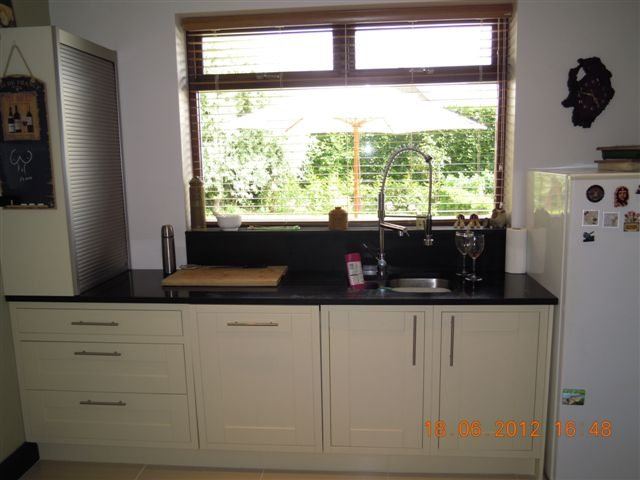
For many people the kitchen became the most important room in the house, and often the first thing buyers look at. Handleless and high-gloss kitchens sat alongside a revival of Shaker and in-frame styles, and a huge choice of colours, materials and sizes made a high level of personalisation affordable.
The 2020s: the kitchen today
Open-plan kitchen-living-dining rooms are now the norm in many homes, with islands doubling as dining tables and workspaces. Colour has returned, with deep greens and blues, warm neutrals and two-tone schemes. Matt finishes, quartz worktops, induction hobs, boiling-water taps and energy-efficient appliances are popular, and hard-wearing materials that last are in demand.
Whatever your style, from classic Shaker to sleek handleless, the choice has never been wider. Browse our kitchen ranges, or send us your measurements for a free design.